


The Planetary Justice Alliance is:
a leading global alliance of justice advocates holding the culpable to account.
Alliance (noun): "a group of countries, political parties, or people who work together because of shared interests or aims, or the act of forming such a group:" (Cambridge Academic Content Dictionary)
Study
Scholars from all over the world can find informative articles about judicial corruption, misconduct and unethical practices on our website.
Research
We work to hold the least accountable and most powerful part of government to account - courts and tribunals.
Partners & Community
We collaborate locally and globally to expose crimes against humanity committed by legal practitioners, courts, tribunals, and parties to legal proceedings.
About PJA
We educate and work with outstanding minds to build a brighter future for our planet, without tyranny and corruption.


Core Work
You will find our foremost legal strategists, research analysts, policy experts, scientists (and more) following the money (whether it be green-washing social responsibility initiatives or fake foreign aid) - not in tribunals or courtrooms convincing tribunal members, magistrates and judges of injustices.
Let's shift the burden of proof where it is due by looking at the data. Despite what many individuals and organisations believe and promote, the law is not being used as the most powerful tool to address the most existential threat we face as a species (the climate crisis). In fact, despite there being over 190 member states of the UN, which have signed the Universal Declaration of Human Rights, corporations are increasingly enjoying more rights and privileges than living beings (who the law generally defines as "natural persons", as opposed to "artificial" or "legal" persons: corporations).
Indeed, the greatest financial and environmental crimes of this century are being committed by ruthless, unaccountable corporate actors: from shell companies, publicly listed corporations and, yes, even non-profit foundations and charities (in fact they are some of the worst offenders) – not actual human beings. For instance, rather than upholding their charters (charitable causes), many foundations and charities do little more than serve to minimise the taxes of their board of directors and trustees. According to CharityWatch, a charity can spend 99% of your donation on its overheads without breaking any laws.

Find a Competent Legal Practitioner (Coming Soon)
PJA can help you find solicitors, lawyers, barristers and Kings Counsels that you can trust to secure your future.
Find
Near
Services for Law Practices:
List Your Practice For Free
Get Accredited
Trust Hub
Join Our Newsletter!
Stay in the know! PJA researches, summarises and provides reliable, factual, evidence-based information and news reports on judicial corruption, misconduct and unethical practices. Our newsletters are carefully curated, drawing from a diverse spectrum of sources.


Become a Member for FREE! 😃
We’d love you to join us. We welcome your involvement and value your contribution. With your help we can continue to make a difference!
⚔️ If you are a lawyer, judge, magistrate, tribunal member, healthcare professional (e.g. physician, medical doctor), scientist, politician or journalist who wants to help PJA tackle judicial corruption, misconduct and unethical practices, we invite you to join our international network by filing out the form below.
💰 We are one of the few alliances which does not have different tiers of membership, reflecting the financial capacity of you as our member. Why? Membership is free thanks to our devoted supporters who dedicate extensive time on a pro bono basis.
Become a Part of Our Team - Join Our Advisory Board!
We rely on the expertise of our dedicated Advisory Board members. You are welcome to nominate yourself or somebody qualified you know (e.g. a friend, associate or colleague).
Benefits of Becoming a Member
-
Membership brings inclusion in our network of learned researchers and professionals across a wide range of disciplines.
-
Provides opportunities to advance the evolution of science and culture in Australia, and is an avenue through which individuals can share in the work of PJA.
-
Members help shape the direction of our organisation.
-
The more members we have, the bigger our voice and the better we’ll be able to promote justice and equity ('fairness') through shedding light on corrupt practices in the legal profession and holding the culpable to account.
-
The great feeling you get when making a positive difference.
Your support assists us with:
-
Working with decision makers to implement legislation and policies that ensure the ones in need get the help they need.
"🏡 While on average, $1.26 million has been spent per exonerated inmate who is facing the death penalty, countless children and families remain impovershed without food on their table, clean water, shoes on their feet, basic sanitation, and live without a roof over their heads." - PJA
PJA's Blog
Welcome
🌎 Welcome to the official website of the Planetary Justice Alliance (PJA), pronounced 𝘗𝘑.
We embrace a bold and courageous vision of cultural renewal, community and building a brighter future by uncovering and educating the public on the little-known systemic forces underlying the legal, political and economic structures shaping our world, which continue to fuel judicial malpractice, injustice and deterioration of quality of life and the very fabric holding civilisation together.
🌍 Founded on September 11, 2020: the Day that Changed the World (U.S), the Day of Destiny (Israel), and the Day of Fate (Germany), PJA is a one-of-a-kind international alliance committed to maintaining international peace, law and order.
🌐 PJA is a far-reaching international network of courageous, dedicated researchers and concerned citizens from around the globe with diverse backgrounds in media activism, journalism, high-level government work, academia, social justice advocacy, grassroots organising, and life sciences such as medicine, psychiatry, psychology and philosophy, supporting governments, their citizens, corporations, and non-profits to advance development, fight corruption, and promote rights for our planet (not only our people) worldwide are the core pillars of PJA's work.
⚖️ PJA crafts and advocates for non-partisan solutions to make state and territory-level tribunals, courts (e.g. local, district, supreme), and the federal courts more open and accountable to all participants of civil and criminal justice systems, as well as help nations develop more robust policies, partnerships and institutions.
Individuals who have made valuable contributions about judicial corruption, misconduct and unethical practices
-
Jed S. Rakoff — A senior judge of the United States District Court for the Southern District of New York and an adjunct professor at both Columbia University Law School and New York University Law School:
-
Since going on the bench in 1996, Rakoff has authored more than 1,800 judicial opinions.
-
Has served as a commissioner for the National Commission on Forensic Science and as cochair of the National Academy of Sciences’ committee on eyewitness identification.
-
Has also assisted the U.S. Departments of Commerce and State in training judges in a dozen countries.
-
Regular contributor to The New York Review of Books.
-
He is also the author of Why the Innocent Plead Guilty and the Guilty Go Free: And Other Paradoxes of Our Broken Legal System (Farrar, Straus and Giroux, 2021).
-
In 2014, he was listed by Fortune magazine as one of the World’s 50 Greatest Leaders.
-
-
James J. Duane — An American law professor at the Regent University School of Law, former criminal defense attorney, and Fifth Amendment expert:
-
James Duane became a viral sensation in 2008 for a lively lecture that explained why people shouldn’t agree to answer questions from the police. In his book, You Have the Right to Remain Innocent, Duane expands on that presentation, offering a vigorous defense of every citizen’s constitutionally protected right to avoid self-incrimination by using case histories of innocent persons who were wrongfully imprisoned because of information they gave to police.
-
Professor James Duane teaches at Regent Law School, where he received the Faculty Excellence Award in the Fall of 2002.
-
Twice taught as a Distinguished Visiting Professor at William and Mary Law School in Williamsburg, Virginia.
-
During the 2013-14 academic year, he served as a faculty associate at Harvard University’s Berkman Center for Internet and Society.
-
Awarded the Distinguished Faculty Achievement Award by the Virginia State Council of Higher Education for Virginia in 2002.
-
Clerked for the Honorable Michael A. Telesca of the United States District Court for the Western District of New York and the Honorable Ellsworth A. Van Graafeiland on the United States Court of Appeals for the Second Circuit.
-
Was senior associate at the law firm of Connors & Vilardo in Buffalo, New York, where he practiced civil litigation and criminal defense, and was trial counsel for all of the defendants in Schenck v. Pro-Choice Network of Western New York, 519 U.S. 357 (1997).
-
-
Brian Martin — Emeritus professor of social sciences at the University of Wollongong, Australia:
-
Martin is the author of 23 books and hundreds of articles on nonviolence, whistleblowing, scientific controversies, information issues, democracy and other topics.
-
Vice president of Whistleblowers Australia and runs a large website on suppression of dissent.
-
Did You Know?
“Felix Frankfurter is one of the most cantankerous and controversial figures in the history of American law. By some accounts, he broke the Court, and it has never been right since. The pilfering of his papers was a disaster, but it’s nothing compared with the loss to the historical record that happens every day, a block away, in the chambers of the U.S. Supreme Court. The papers of Supreme Court Justices are not public records; they’re private property. The decision whether to make these documents available is entirely at the discretion of the Justices and their heirs and executors. They can shred them; they can burn them; they can use them as placemats. Texts vanish; e-mails are deleted. The Court has no policies or guidelines for secretaries and clerks about what to keep and what to throw away. Some Justices have destroyed virtually their entire documentary trail; others have made a point of tossing their conference notes. “Operation Frustrate the Historians,” Hugo Black’s children called it, as the sky filled with ashes the day they made their bonfire.”
- Jill Lepore
November 24, 2014
“Most states are shielding critical information about their supreme court justices from the public, either by making disclosures hard to obtain or by requiring scant information to be disclosed
State supreme court justices have the power to impact federal elections, redistricting, immigration, reproductive rights, gun rights and more, and yet most states are suppressing information about their top judges — either by making it difficult to obtain financial disclosure reports or requiring little to no information to be disclosed — in a way that shields them from accountability, according to a new report released today by Fix the Court.”
“ ‘Despite all we’ve learned in recent years about the might and impact of state supreme courts, not to mention major ethics scandals from West Virginia to Wisconsin to Texas, most states appear to be okay with keeping judicial disclosures hard to locate and short on detail,’ FTC’s Gabe Roth said. ‘Yet if the public doesn’t know what type of gifts and free trips a justice has received during the year, or what investments they have, then we can’t be certain a justice is truly unbiased no matter what cases come before them. Our report shows the clear case for urgent reform.’ ”
March 14, 2024
Dear concerned citizens,
Our civil and criminal justice systems are tasked with maintaining public safety and upholding the rule of law. Yet far too often, social justice takes a backseat while those in authority violate inalienable human rights.
Information Pollution
When information pollution exists in the mainstream media we end up with societies that are overwhelmed with information and where truth can be somewhat elusive. Indeed, a significant portion of the populace can't even tell truth from fiction anymore.
Are you aware that innumerable documentaries, research papers, congressional reports / hearings, books, websites and articles (a selection has been curated and summarised on our website), along with hundreds of freedom organisations, international appeals and open letters throughout the world, addressed to the top leaders at the United Nations, the World Health Organization (WHO), the UN Environment Program, and all member States across the globe, supported / endorsed by thousands of sincere, educated, intelligent, highly credentialed experts (see below for summary) prove beyond the shadow of a doubt that global civil and criminal justice systems (in both the developed and developing worlds) are riddled with corruption, misconduct, unethical practices, junket judges, magistrates and tribunal members who trample the conditions of their appointments (e.g. code of conduct, service charter, and obligations of diligence, impartiality and integrity), along with constitutions, statutes, case precedents, international agreements, contracts, medical codes, etc.?
Award winning journalists who have won almost every honour in broadcast journalism (including several Emmy Awards, a Pulitzer Prize, a Peabody Award, a Murrow Award, the Goldman Environmental Prize, and received citations from scholarly, professional, and charitable organisations); scientists; professors; healthcare professionals (e.g. medical doctors and physicians: generalists and specialists); legal practitioners; judges; law enforcement officers; current and former heads of state and government (e.g. Presidents, Prime Ministers, Former Governor General of Canada, Former Chancellor of Austria, etc.); Nobel Laureates; civil society organisations, current and former government and intergovernmental organisation officials; including representatives and leaders of civil society, academia, business, and faith communities.
Many individuals have personally experienced the effects of tyranny and arbitrary removal of their rights, freedoms, privacy and possessions. However, too few in positions of authority condemn the inequities of our legal systems. Meanwhile, judges, tribunal members, legal practitioners (e.g. solicitors, attorneys, lawyers, barristers), law enforcement officers, and representatives (e.g. real estate agents) break laws with impunity.
How long will we keep pretending:
-
That our justice systems work?
-
That there is such a thing as objectivity?
-
That self-selecting biases and the failures of justice systems have disengaged, disempowered and confused populaces around the world?
-
That countries which are seen as the leaders of the western world in a lot of ways are in massive crisis?
Verifiable Facts to Change Our World and Build a Brighter Future
PLEASE TAKE THE TIME TO READ THE FOLLOWING NON-EXHAUSTIVE LIST TO GAIN A BETTER UNDERSTANDING OF THE EXTENT AND PREVALENCE OF JUDICIAL CORRUPTION, MISCONDUCT AND UNETHICAL PRACTICES.
All information is taken from the most reliable sources available and can be verified using the links provided to trusted information sources. The PJA team presents this information as an opportunity for you to educate yourself and others, and to inspire you to strengthen democracy and to work together for a brighter future.
-
If these things are possible, so too are just about anything else. If we can't trust our justice systems, who can we turn to?
-
If the facts presented here were reported in headline news where they belong, wouldn't concerned citizens be astounded and demand to know more?
This has not happened, which is partly why PJA was founded. Don't stay silent. It is high time to do something. Being aware of or witnessing human rights abuses and standing by is a form of complicity, which is effectively the same as allowing the offences / crimes to happen.
We welcome you to learn more about our work and to join us in transforming our world for the better. To learn how, click here. We encourage everyone to join PJA. The world needs us more than ever.
Did you know that:
-
⚕️ Medical licenses are being used as licences to betray patients, whereby sexual abuse by medical doctors (GPs and physicians) is tolerated by regulators and forgiven in every state across the U.S., and that the medical profession shields doctors’ abuse nationwide, leaving patients traumatised and in the dark?
-
More than 2,400 U.S. doctors were sanctioned for sexually abusing their patients, according to a revelational reporting (2016-2017) that surveyed records from all 50 states and reveals the nationwide scope of the problem, or that more than 450 doctors had been brought before medical boards or courts in 2016 and 2017 for cases involving sexual misconduct.
-
State medical boards, which oversee physicians, allowed more than 50% of the sanctioned doctors to keep their licenses even after the accusations of sexual abuse were determined to be true, according to a yearlong investigation.
-
-
🏛️ Thousands of U.S. judges who broke laws or oaths remained on the bench: As part of its Teflon Robe project / investigation, Reuters identified and reviewed 1,509 cases from the last dozen years (2008 through 2019) in which U.S judges resigned, retired or were publicly disciplined following accusations of misconduct. Thousands of state and local judges across America have been allowed to keep positions of extraordinary power and prestige after violating judicial ethics rules or breaking laws they pledged to uphold.
-
The news agency's investigation identified 3,613 cases from 2008 through 2018 in which states disciplined judges privately withholding from the public details of their offences, including the identities of the judges themselves.
-
🏃 In many states, the lack of aggressive public oversight means that judges may behave with impunity.
-
In the unlikely case that judges are publicly charged with misconduct, many states enable judges to simply resign or retire, effectively putting a stop to the charges and any investigation of potential wrongdoing.
-
Reuters found that at least 341 judges across the United States escaped punishment or further investigation in the past dozen years by resigning or retiring amid misconduct allegations.
-
At least 5,206 people were directly affected by a judge's misconduct. The victims ranged from people who were illegally jailed to those subjected to racist, sexist and other abusive comments from judges in ways that tainted the cases.
-
For instance, Reuters found that city police, the sheriff's office, the state police, the Federal Bureau of Investigation (FBI) and a federal grand jury investigated Tim Parker, 58 (lawyer and a part-time judge) for about four years. Witnesses gave evidence that the judge disclosed the identity of a confidential informant; traded money and opioids for sex; and gave favorable treatment to young women in his courtroom, Reuters found. Despite the intense scrutiny, Parker was never charged with any crime.
-
All told, 9 of every 10 judges were allowed to return to the bench after they were sanctioned for misconduct, Reuters determined. They included:
-
A California judge who had sex in his courthouse chambers;
-
A New York judge who berated domestic violence victims;
-
A Maryland judge who, after his arrest for driving drunk, was allowed to return to the bench provided he took a Breathalyzer test before each appearance;
-
-
An Arkansas judge who styled himself as a Sugar Daddy stood accused by local women of soliciting sex in exchange for cash, drugs, and bail leniency, largely escaped accountability from authorities for years, a Reuters investigation found. Yet afterwards, he continued to practice law despite his misconduct.
-
-
🤝 Legal immunities: Meanwhile, with judges judging judges, rogues on the bench have little to fear.
-
⏩ Emergency proceedings: The U.S. Supreme Court does not always receive full briefs on legal matters or hear oral arguments, and override the normal sequence of appellate proceedings to issue their orders. The “shadow docket”, the so-called emergency proceedings now constitute the majority of the Supreme Court’s business. Minimally argued, rarely justified and decided without transparency, shadow docket orders were once a tool the court used to dispense with unremarkable and legally unambiguous matters.
-
👀 Secret revisions of decisions: The U.S. Supreme Court has been quietly revising its decisions years after they were issued, altering the law of the land without public notice.
-
👮 Domestic abuse (verbal and physical assault) by police officers: Jonathan Blanks, a Cato Institute researcher reported that in the thousands of news reports he has compiled, domestic violence is the most common violent crime for which police officers are arrested. And yet, most of the arrested officers appear to keep their jobs. In 2016, an ABC 7 investigation found that nine of every 10 domestic violence allegations made against Chicago police officers by spouses or children resulted in no disciplinary action.
-
Courts can be perilous to navigate, too, since police intimately understand their workings and often have relationships with prosecutors and judges.
-
Police are also some of the only people who know the confidential locations of shelters.
-
Diane Wetendorf, a domestic violence counselor who wrote a handbook for women whose abusers work in law enforcement, believes they are among the most vulnerable victims in the country.
-
States like Texas make it nearly impossible to obtain records in police abuse cases.
-
-
👮 Sexual abuse (rape) by police officers: A police officer in India was arrested after being accused of raping a 13-year-old girl who went to his station to report she had been gang-raped. In 2022, the alleged incident was the latest to spotlight the high levels of sexual violence in the world's largest democracy, where a woman is raped every 18 minutes on average. Police said the officer was arrested along with four other people and the girl's aunt, who was reportedly inside the station house room when she was attacked. Twenty-nine other officials present at the police station in the northern state of Uttar Pradesh at the time of the alleged assault were suspended from duty.
-
India has long been plagued by sexual violence against women.
-
India's rape laws and sentencing guidelines were overhauled after the 2012 Delhi rape and murder of a young medical student.
-
But the number of offenses remains high, with more than 28,000 rapes reported in 2020, according to the latest official data (as of 2022), which is thought to be just the tip of the iceberg.
-
-
👮 Sexual assault and rape victims turned into suspects and charged with lying: There are many reasons for women to think twice about reporting sexual assault. But one potential consequence looms especially large: They may also be prosecuted. A retired police lieutenant in Memphis, Tenn., Cody Wilkerson, testified, as part of a lawsuit against the city, not only that police detectives sometimes neglected to investigate cases of sexual assault but also that he overheard the head of investigative services in the city's police department say on his first day in charge: The first thing we need to do is start locking up more victims for false reporting. In 1997, a legally blind woman reported being raped at knife point in Madison, Wis. That same year, a pregnant 16-year-old reported being raped in New York City. In 2004, a 19-year-old reported being sexually assaulted at gunpoint in Cranberry Township, Pa. In all three instances, the women were charged with lying. In all three instances, their reports turned out to be true. The men who raped them were later identified and convicted.
-
Meanwhile, a billionaire pedophile the police wanted to be locked up for life got a slap on the wrist.
-
-
👨👧 Leglised child marriage: Child marriage is still legal in most of the U.S. due to loopholes in state and federal laws.
-
🔞 Legalised child pornography: Meanwhile, in many countries it is perfectly legal to watch child pornography (real or fictional, including possessing pornographic material).
-
In 2016, throughout 17 years of operation, PS the Children, Malaysia's biggest NGO dealing with child abuse, saw zero convictions on the cases it handled, its founder Madeleine Yong told Reuters.
-
-
🤰 Innocent women arrested and tortured to boost arrest figures: According to damning research by Amnesty International, including reports to judges, prosecutors, doctors, and the National Commission for Human Rights, in Mexico, innocent women (young, poor, single mothers) have been illegally arrested and tortured by Mexican security services looking to boost arrest figures. Over 70% of the women interviewed said they were sexually abused during or soon after being arrested. Ten of the women were pregnant when arrested; eight subsequently suffered a miscarriage. Most spent years in prison awaiting trial without access to adequate healthcare or legal advice.
-
👨🏾🦱 U.S. taxpayers spent almost $1 billion incarcerating innocent black men and women:
-
According to the National Registry of Exonerations (NRE), since 1989, 2,515 men and women have been exonerated after proving their innocence. In total, among all known exonerees, Americans have shelled out a staggering $4.12 billion to incarcerate innocent men and women since 1989. Thats largely money spent on trials, and the cost of housing inmates in prison.
-
Since 1989, taxpayers have wasted $944 million to incarcerate black men and women that were later found to be innocent. That number climbs to $1.2 billion when including Hispanic men and women. On average, from the time a person enters the criminal justice system until they are exonerated, $1.26 million is spent per inmate who is facing the death penalty. The total sum $4.12 billion spent on all known exonerees also includes $2.2 billion that taxpayers have paid the innocent in compensation since 1989 for the time they were imprisoned, according to a 2018 NRE study. But while a large sum, only 44% of exonerees have ever received compensation.
-
-
🕵️ DOJ review of flawed FBI forensics processes lacked transparency:
-
Attorney General Janet Reno and FBI Director Louis J. Freeh decided to launch a task force to dig through thousands of cases involving discredited agents. The task force took nine years to complete its work and never publicly released its findings.
-
Officials never notified many defendants of the forensic flaws in their cases and never expanded their review to catch similar mistakes.
-
If the Justice Department was secretive, the agency’s independent inspector general was not. Michael R. Bromwich’s probe culminated in a devastating 517-page report in April 1997 on misconduct at the FBI lab. He concluded that FBI managers failed — in some cases for years — to respond to warnings about the scientific integrity and competence of agents.
-
The chief of the lab’s explosives unit, for example, “repeatedly reached conclusions that incriminated the defendants without a scientific basis”.
-
-
👨⚖️ Many courts screw innocent victims into pleading guilty: An essay by senior federal district judge, Jed A. Rakoffs in The New York Review of Books attempted to explain why innocent people too often plead guilty. At the time (2014), at least 20,000 people had pled guilty to and gone to jail for felonies they did not commit. Rakoff identified three ways the criminal justice system obstructs its own truth-seeking mechanism, a trial by jury.
-
Dishonest prosecutors: In 2018, prosecutors of the U.S. Justice Department were caught withholding massive amounts of evidence undermining federal charges.
-
-
📜 Judicial errors take high tolls on inmates and taxpayers: 692 felony convictions in California were thrown out between 1989 and 2012 based on errors or misconduct by police, prosecutors, defense lawyers or judges, according to a study (2016) by researchers at UC Berkeley and the University of Pennsylvania.
-
The report didn't include misdemeanor cases, which amount to about 80 percent of all prosecutions, or juvenile cases. And it also excluded the costs of jailing people who were later released without charges, which may amount to $70 million a year, the report said.
-
The study examined only records from California and looked at cases in which felony convictions were overturned and the defendants were later cleared. More than half the cases involved prosecutors wrongful withholding of evidence.
-
The authors questioned long-standing laws that shield prosecutors from lawsuits by criminal defendants. They said they knew of no other profession that received immunity for intentional wrongdoing that gravely injures another.
-
-
⚰️ Nearly 5,000 died in U.S. jails without getting their day in court: In an unprecedented examination of mortality in more than 500 U.S. jails from 2008 to 2019, Reuters documented 7,571 inmate deaths. Death rates have soared in those lockups, rising 35% over the decade ending last year. Casualties are typical: held on minor charges and dying without ever getting their day in court. At least two-thirds of the dead inmates identified by Reuters, 4,998 people, were never convicted of the charges on which they were being held. Reuters is making the full data it gathered available to the public here.
-
🤬 Over 3,000 U.S. prisoners served life without parole for non-violent crimes: The report: A Living Death, by American Civil Liberties Union (ACLU), chronicles the thousands of lives ruined and families destroyed by the modern phenomenon of sentencing people to die behind bars for non-violent offences.
-
Taxpayers paid an additional $1.8bn to keep the prisoners locked up for the rest of their lives. About 65% of the prisoners identified nationwide by the ACLU were African American.
-
A black man is serving life in prison for stealing hedge clippers.
-
Crystal Mason, the woman who became the poster child for voter suppression when she was sentenced to five years for casting a ballot in Texas, went into federal prison. Masons crime was to cast a ballot in the 2016 presidential election.
-
Fort Worth has been particularly hardline, not only prosecuting Mason but also going after a Hispanic woman, Rosa Ortega, for mistakenly voting as a non-US citizen. Ortega, 37, who had permanent resident status in the US having come to the country as an infant, was sentenced to eight years in prison to be followed by deportation.
-
-
🏭 Polluting with impunity: Governments fail to limit thousands of dangerous, understudied and unstudied chemicals in consumer products, medical treatments (e.g. feeding tube liquid given to babies and children with cancer in hospitals), food, water supplies, and the air we breathe, such as lethal, toxic, carcinogenic, mutagenic, genotoxic, neurotoxic, reproductive toxic, endocrine and nervous disruptors' (ENDs), and radioactive chemicals associated with severe health complications at the immune, metabolomic, and neuroactive levels.
-
Meanwhile, chemical manufacturers polluting our planet's ecosystems and causing irreversible birth defects are getting off scot-free with exemptions and permits / licenses to pollute.
-
-
📝 Corporations stacking the deck of justice through arbitration: By inserting individual arbitration clauses into a soaring number of consumer and employment contracts, companies have devised a way to circumvent the courts and bar people from joining together in class-action lawsuits, realistically the only tool citizens have to fight illegal or deceitful business practices. It has become increasingly difficult to apply for a credit card, use a cellphone, get cable or Internet service, or shop online without agreeing to private arbitration. The same applies to getting a job, renting a car or placing a relative in a nursing home. By banning class actions, companies have effectively disabled consumer challenges to predatory lending, wage theft and discrimination. This is among the most profound shifts in our legal history, William G. Young, a federal judge said in an interview. Ominously, businesses have a good chance of opting out of the traditional legal system altogether and misbehaving without reproach. Thousands of cases brought by single plaintiffs over fraud, wrongful death and rape have been decided behind closed doors. And the rules of arbitration largely favour companies.
Together we can build an improved world and brighter future for us, our children, our grandchildren and our planet.
The future is bright, if we each all do our part.
For a transformed world,
Planetary Justice Alliance 🕊️
9 May 2024
Proudly Supporting
PJA supports concerned individuals, current and former officials, legal practitioners, judicial officers, registrars, tribunal members, magistrates, judges, non-lawyers (e.g. journalists, self-represented litigants), business leaders, and representatives of civil society and government, dedicated to:
-
Investigating corruption, injustices, and abuses of power in state, territory-level and federal governments;
-
Promoting reforms that remove major barriers to meeting the UN Sustainable Development Goals, strengthening human rights, public health, and international peace and security to build more transparent, impartial, and accountable governments and government sector employees.
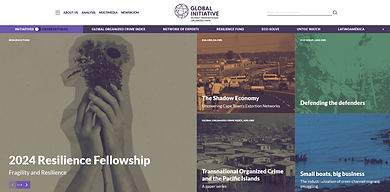.png)
"The Global Initiative was born from a series of high-level, off the record discussions between mainly (though not exclusively) law-enforcement officials from both developed and developing countries in New York in 2011–12. At these meetings, the founding members of the Global Initiative, many of whom stand at the front line of the fight against organized crime, illicit trafficking and trade, concluded that the problem and its impacts are not well analyzed; they are not systematically integrated into national plans or strategies; existing multilateral tools are not structured to facilitate a response; and existing forms of cooperation tend to be bilateral, slow and restricted to a limited number of like-minded states."

"Grand corruption – the abuse of public power for private gain by a nation's leaders – is a major barrier to meeting the UN Sustainable Development Goals, fighting climate change, promoting democracy and human rights, establishing international peace and security, and securing a more just, rules-based global order. It does not endure due to a lack of laws. There are 190 parties to the United Nations Convention against Corruption (UNCAC), which requires them to have laws criminalizing varying forms of corruption. However, corrupt government officials – known as kleptocrats – have impunity in their own countries because they control the police, prosecutors, and courts."
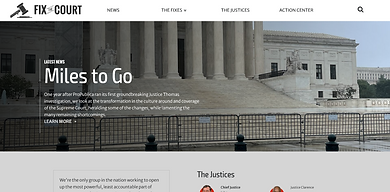
"Fix the Court is a nonpartisan, 501(c)(3) nonprofit organization (EIN: 86-1840317) that advocates for non-ideological 'fixes' that would make the federal courts, and primarily the U.S. Supreme Court, more open and more accountable to the American people.
You can read more on the 'fixes' — greater media and public access, Supreme Court term limits, new and robust ethics rules, stronger recusal rules, comprehensive online disclosures, and public appearance notifications — here."

"We investigate corruption, injustice, and abuse of power in the federal government. And we promote commonsense reforms that strengthen our democracy and build a more equitable, accountable government."

"Free Law Project is the leading nonprofit using technology, data, and advocacy to make the legal ecosystem more equitable and competitive."
Our founders are supported by researchers / academics from:
Universities





Institutes

Finance


Government


Life Sciences








Philanthropy and Aid


Advisors


Royal Society of New Zealand

Founders work:
Our founders work is supported by the PRC, the world’s leading research and educational centre focused on the visual dimensions of art, science, and technology. A sampling of organisations that have supported the PRC financially over the past 30 years, include (although are not limited to) the universities of: Toronto; Cambridge, York, London, Gottingen, Rome, Carlton, and Maastricht, plus:
Government
The Vatican (The Holy See), the Province of Ontario, and the Canadian Heritage Information Network (CHIN), a Special Operating Agency within the Department of Canadian Heritage,


Foundations and Institutes


Computer Science


Published in:
Our founders work has been published by the Stanford Social Innovation Review (SSIR). Stanford Social Innovation Review (SSIR) is an award-winning magazine and website published by the Stanford Center on Philanthropy and Civil Society at Stanford University that covers cross-sector solutions to global problems. SSIR is written by and for social change leaders from around the world and from all sectors of society—nonprofits, foundations, business, government, and engaged citizens. SSIR informs and inspires millions of social change leaders.
SSIR’s mission is to advance, educate, and inspire the field of social innovation by seeking out, cultivating, and disseminating the best in research- and practice-based knowledge. With print and online articles, webinars, conferences, podcasts, and more, SSIR bridges research, theory, and practice on a wide range of topics, including human rights, impact investing, and nonprofit business models.


Exposing Problems
We investigate corruption, injustice, and abuse of power in our government, exposing systemic problems that endanger our democracy.

Developing Solutions
We craft commonsense policy reforms to tackle systemic corruption and abuse of power, protect constitutional rights, and ensure the government works for all people.

Advocating for Change
We push policymakers to enact reforms that will strengthen public trust in government. We take our policy proposals straight to those in power, and we empower our supporters to lobby their members of Congress for change.
Information Centres
The PJA has a dedicated mission to provide our readers with reliable, verifiable information.
We compile information from trustworthy sources. The perspectives we draw upon are varietal, and they’re not always aligned with social consensus. Our approach invites our readers to make better sense of the complex issues society is facing, in order to be informed and balanced in our thinking. To help with this sensemaking, we’ve put together Information Centers on all areas of law encompassing the most critical topics.
Contract
Consumer
Commercial
Competition
Property
Trusts & Estates
Real Estate
International
Technology
Administrative
Litigation
Procedural
Common
Constitutional
Statutory
Tort
Criminal
Corruption


Planet
Enviromental
Animal
Tax
Non-Profit
Did you know: ‘A charity can spend 99% on overhead without breaking the law!’?
“CharityWatch CEO, Laurie Styron, explains how a charity can spend 99% of your donation on overhead and only 1% on its programs without breaking any laws.”
– Laurie Styron, CEO, CharityWatch
Leading independent charity watchdog organization in the US
Healthcare
Health
Public Health
Bioethics
Medical
Iatrogenic Diseases and Deaths
There were a total of 3.35 million deaths in the US in 2020. And the third leading cause? Iatrogenic death – literally death by healer – causing approximately 400,000 hospital deaths. (The Covid death toll in the United States in 2020 was 345,000.)
However these figures of iatrogenic deaths do not take into account iatrogenic diseases from the long-term harm done by medical treatments where patients survive but with one or more chronic diseases.
Michael Saks and Stephan Landsman wrote a book that takes a deep dive into iatrogenic injury and death: ‘Closing Death’s Door: Legal Innovations to End the Epidemic of Healthcare Harm’ (Oxford University Press, 2021), which argues that the principal economic counterforce to such errors, malpractice litigation and the tort system, has never been a particularly effective deterrent for a host of reasons, with fewer than 3% of negligently injured patients or their families receiving any compensation from a doctor or hospital’s insurer.
“More than 400,000 Americans die every year because of medical errors,” Landsman says. “That number, greater than the Covid toll, and suffered each and every year, was invisible except for the occasional celebrity death of people like Joan Rivers.”
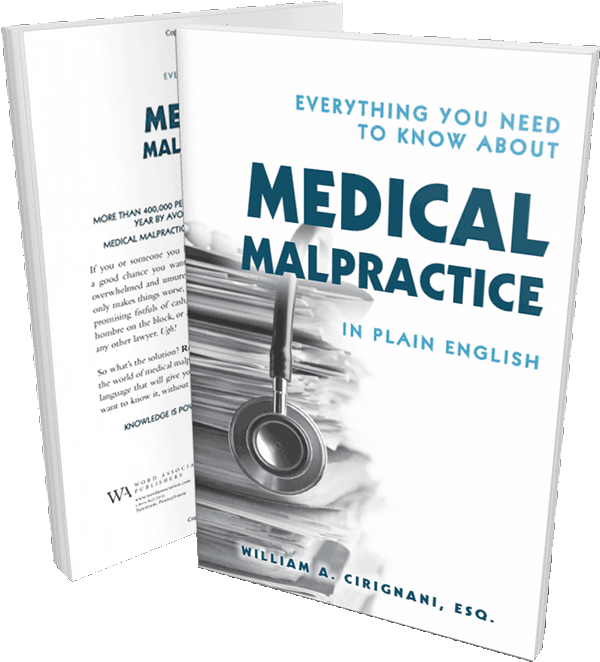
"We literally wrote the book on Medical Malpractice, and we want to help you understand the ins and outs of dealing with troubling times.
More than 400,000 people are maimed or killed every year by avoidable medical errors. Medical malpractice is real and it’s devastating.
This book is your roadmap to the world of medical malpractice, written in easy-to-understand language that will give you what you need to know, when you want to know it, without pressure from anyone.”
- Cirignani Heller & Harman, LLP


Intellectual Property
Media
Entertainment
Trade Mark
Copyright
Patent
The value of S&P 500 intangible assets are more than 5x tangibles and comprise approximately 90% of the value of the S&P 500 companies

The value of S&P 500 intangible assets are more than 5x tangibles (IP CloseUp, 2020) and comprise approximately 90% of the value of the S&P 500 companies (IP CloseUp, 2021; Visual Capitalist, 2020). Today, tangible assets like real estate and equipment comprise just 16% of company value, while intangible assets, such as IP rights and reputation, make up approximately 84%. In only 43 years, intangibles have evolved from a supporting asset to a primary consideration for investors (Dennemeyer Group, 2020).
The international intellectual property system has governed world trade for thousands of years and affects virtually every sphere of life on earth: labour, music, land use, food, agriculture, natural resources, the environment, state-owned enterprises, mergers and acquisitions, government procurement and regulations for financial services, banking and finance, healthcare, energy, telecommunications, chemical production, and the motor industry – to name a few.
However, intellectual property rights (e.g. patents, trademarks and copyrights) have become controversial. Many say that intellectual property helps rather than hinders the competitive free market regime that has delivered wealth and innovation to our doorsteps.
“ ‘In 2015, no-one really knew what IP-backed financing was – there was only litigation financing available for SMEs,’ says Rementilla. She recognized the inefficiency in the capital markets and the difficulty that innovative companies faced in raising finance. ‘These companies had patents, know-how, software, data and customer contracts – and yet the markets didn’t attribute any value to it,’ she explains.” […]
“The worldwide value of intangible assets grew from USD 61 trillion in 2019 to USD 74 trillion in 2021, according to the Brand Finance Global Intangible Finance Tracker. In addition, Ocean Tomo research has found that intangible assets account for 90 percent of the value of S&P 500 companies. Yet many intellectual property (IP)-rich companies, particularly start-ups and small and medium-sized enterprises (SMEs), struggle to secure financing. Why? One reason is investors find it hard to value and analyze intangible assets (e.g. know-how and data) compared to physical (tangible) assets such as real estate, machinery and stock.” […] “Finding ways to unlock intangible asset finance, and solve the problem of IP financing, is becoming a priority around the world.” […] “As WIPO Director General Daren Tang said in his opening remarks to the High-level Conversation: ‘Intangible assets are like the dark matter of our financial world – mysterious and largely invisible, even if they are now exerting a huge and increasingly visible influence on our companies and economies.’”
[…] “And it is not just about patents and technology: in July 2020 American Airlines raised USD 1.2 billion in a loan form the merchant banking arm of Goldman Sachs, USD 1 billion of which was secured by the company’s trademark and domain name rights.”

"Top pop writers are asking their peers to support the Pact, an open letter calling for fairer treatment in an industry that often takes them for granted".

Top Songwriters Ask Artists & Execs to Stop Taking Credit for Songs They Didn’t Write in Open Letter
"Top songwriters including Emily Warren, Justin Tranter and Ross Golan are taking a stand against what they view as unfair practices in the music industry where artists and executives who did not write on a song take credits on it anyway."

Areas of Interest
Climate Action
Maladministration
International Law
Education
Administrative Law
Philanthropy
Human Rights
Corruption
From judicial corruption to promoting reforms that remove major barriers to meeting the UN Sustainable Development Goals, we help developed and developing nations to address the most pressing local and global development issues.
Research
Explore analysis and advice on judicial corruption.
Access a growing repository of informative articles on judicial corruption, misconduct, unethical practices, and more...
Essential reading


DID YOU KNOW?
More than 50% of all wrongful criminal convictions are caused by government misconduct!
A new study digs into the reasons people are wrongly convicted, and it has found that 54 percent of those defendants are victimized by official misconduct, with police involved in 34 percent of cases, prosecutors in 30 percent, and some cases involving both police and prosecutors.
The study (click here) by the National Registry of Exonerations reviewed 2,400 exonerations it has logged between 1989 and 2019, nearly 80 percent of which were for violent felonies. Of the 2,400, 93 innocent defendants were sentenced to death and later cleared before they were executed. The study also found that police and prosecutors are rarely disciplined for actions that lead to a wrongful conviction. Researchers found that 4 percent of prosecutors involved in those convictions were disciplined, but the penalties were comparatively mild and only three were disbarred. Police officers were disciplined in 19 percent of cases leading to wrongful convictions, and in 80 percent of those cases officers were convicted of crimes, such as Chicago police Sgt. Ronald Watts, who led a group of officers who planted drug or gun evidence leading to 66 false convictions.
The 2,400 cases are far from a comprehensive count, since there is no centralized national database of criminal cases at the state and local levels. So an estimate of how often wrongful convictions occur, as a percentage of overall cases, is not possible. The study acknowledges there are other areas to examine, including quantifying ineffective assistance by defense attorneys.
Thousands of U.S. judges who broke laws or oaths remained on the bench
Judge Les Hayes once sentenced a single mother to 496 days behind bars for failing to pay traffic tickets. In 2016, the state agency that oversees judges charged Hayes with violating Alabamas code of judicial conduct.
According to the Judicial Inquiry Commission, Hayes broke state and federal laws by jailing Johnson and hundreds of other Montgomery residents too poor to pay fines. Among those jailed: a plumber struggling to make rent, a mother who skipped meals to cover the medical bills of her disabled son, and a hotel housekeeper. Hayes, a judge since 2000, admitted in court documents to violating 10 different parts of the states judicial conduct code. One of the counts was a breach of a judges most essential duty: failing to respect and comply with the law. Despite the severity of the ruling, Hayes wasnt barred from serving as a judge. Hayes is among thousands of state and local judges across America who were allowed to keep positions of extraordinary power and prestige after violating judicial ethics rules or breaking laws they pledged to uphold, a Reuters investigation found. All told, 9 of every 10 judges were allowed to return to the bench after they were sanctioned for misconduct, Reuters determined. They included a California judge who had sex in his courthouse chambers ... a New York judge who berated domestic violence victims; and a Maryland judge who, after his arrest for driving drunk, was allowed to return to the bench provided he took a Breathalyzer test before each appearance.
Note: Don't miss the entire Reuters series titled The Teflon Robe.
The Shadow Docket
Welcome to the “shadow docket” and “buzz-saw”, the so-called emergency proceedings that now constitute an alarming portion of tribunals (e.g. the NSW Civil and Administrative Tribunal - NCAT) and Supreme Courts (e.g. in Australia, and the U.S.) business, where bias, prejudice, unfair and inequitable hearings, miscarriages of justice, and the practice of bending an opinion to avoid spending time on hearings are so widespread as to be the norm.
What is the shadow docket?
Many participants of the legal profession are exploiting a system that allows them to operate in near secrecy and massage evidence to find what they want to find, and dismiss evidence without much fear of being challenged (appealed), disciplined or prosecuted. Opaque and unconstitutional orders are being issued and dismissed in the shadows, opinions are truncated, based on the ‘colour of the law’ and light on the details of their legal reasoning (e.g. using “balance of probabilities” as a catchall phrase to dismiss any evidence without actually going in legal merits), unsigned, not delivered in a timely manner, vote counts issued without showing how each justice decided, and many times reasons are not issued in writing showing how each member reached his/her decision (thereby not becoming case-law, let alone “persuasive” to future cases / legal arguments). Despite, the enormous legal and human impact that the decisions inflict, all too often they are the product of rushed, abbreviated proceedings – especially in high volume areas / divisions of decision making.
Did you know?


Many people are forced to pursue compensation or restitution through "kangaroo courts" that unjustly reject an alarming quantity of claims they receive, regardless of a claimants evidence.
Many times tribunals and courts do not even brief themselves on the matters before them, nor bother to review written submissions, hear no oral arguments, override the normal sequence of appellate proceedings to issue their orders based on a case-by-case basis with little (if any) regard for case-law, despite being bound to judgments made by courts of law.
Sound reasoning and science are being challenged with partisan potshots, sowing confusion and mistrust, so grave that if judges, tribunal members and legal practitioners did not have legal immunities and were thus treated with the same contempt as the general public they would likely be prosecuted for criminal offences, contempt, and perversion of the course of justice (to name a few).
PJA Resources
The Planetary Justice Alliance is dedicated to providing our network and the general public with reliable, verifiable information.
The Planetary Justice Alliance's site serves as a valuable tool for researchers and a comprehensive archive for educating the public on corruption by non-profits, judicial officers, judges, magistrates, tribunal members, registries, and legal practitioners.
PJA summaries of informative articles
We discuss the news with nuance, uncensored investigation, and compassion for all sides.
Informative articles / posts from external sources
BERNARDGAYNOR.COM.AU
30 April 2018
FLATCHAT, Jimmy Thomson
15 January 2016
Podcast: NCAT still crazy after all these years
FLATCHAT, Jimmy Thomson
20 July 2023
Get out of jail free card at NCAT?
FLATCHAT, Paradise
25 January 2023
What’s the point of NCAT orders if they are just ignored?
FLATCHAT, Whoopi
21 October 2022
Lawyers’ Picnic: NCAT fails to protect whistleblower in case against NSW Health
MichaelWestMedia, Rex Patrick
14 September 2023
Explore the FLATCHAT website for 245 pages of posts about NCAT.
Explore our collection of news articles about judicial corruption, misconduct and unethical practices
The Planetary Justice Alliance researches and summarises reliable and informative news reports on judicial corruption, misconduct and unethical practices, as well as the non-profit / charitable sector, throughout the globe, with vigilance, compassion for all sides, and without prejudice.
Our reports are carefully selected, drawing from the best of the mainstream and independent media landscape. We have thousands of revealing news summaries in our archive so stay tuned. Progressively we will be making them available to our subscribers.


Explore revealing summaries: Explore our full list of revealing excerpts of key major media news articles on judicial corruption, misconduct and unethical practices. All sources can be verified using the links provided to their original, respected sources.
Access full articles, find missing articles, and non-functioning links
If you can't access a link due to it not working, or if the article has disappeared (e.g. a 404 page), you could try Internet Archive or Cached View to locate a copy of the original article. Simply copy the URL of the link that doesn't work and visit archive.org. Paste the copied URL into the designated field and press the "Search archived websites". Once you're there, select the date the article was first published. Archive.org will present you with an exact copy of the webpage on the day it was archived. Keep in mind, though, that any site can request to be excluded from the Internet archive. Regrettably, numerous large-scale news sites have chosen to do this. In such instances, you might attempt to locate the article on another site by using a specific quote from the original source.
The Fixes
Our civil and criminal justice systems are tasked with maintaining public safety and upholding the rule of law. Yet far too often, social justice takes a backseat while those in authority violate human rights .
As long as we choose complacency over awareness, these dysfunctions in the system will continue. The sooner we decide that we do want to know, and that we are willing to invite others in open dialogue about these critical issues, the more we can create a world that supports the greater good of all.
01.
Media and Public Access
02.
Term Limits
03.
Code of Ethics
04.
Stocks, Voting Rights and Recusals
05.
Financial Disclosures



Inspiring Stories
Solutions to society's problems are often under-reported with practical and pragmatic solutions / reforms going unnoticed.
The PJA believes it is important to balance disturbing information with inspirational writings which call us to be all that we can be and to work together for positive change.
The PJA believes it is important to balance disturbing information with inspirational writings which call us to be all that we can be and to work together for positive change. Since its founding, the PJA has summarised and categorised thousands of inspiring news articles (over 3,000) on powerful social change, solutions to the world’s most pressing problems, bridging divides, mysterious explorations into consciousness and spirituality, incredible stories of human goodness and resilience, healing social division and polarisation, healing our bodies, healing the earth, reimagining the economy, reimagining education, repairing the criminal justice system, ending human trafficking, power of art, technology for good, nature of reality and consciousness, and human interest stories (overcoming odds).
Soon we will be making this extraordinary collection of articles and resources available to subscribers.


Disheartening Stories

Mom's Dreams Shattered by Corrupt Prosecutor. She's Fighting Back.
Institute for Justice • Apr 12, 2022 • 37K views
"Everybody knows your prosecutor can’t also be your judge. Everyone, that is, except for former Midland County, Texas, prosecutor Ralph Petty, his supervisor, and the county’s entire system of justice. Petty spent 20 years moonlighting as a law clerk for the same judges he argued before, effectively playing both prosecutor and judge in more than 300 cases. It is one of the most brazen and obvious examples of prosecutorial abuse in modern American history, yet Petty and the others who oversaw this miscarriage of justice have never been held personally accountable for their actions in a court of law. With a lawsuit it filed on April 12, 2022, the Institute for Justice seeks to change that."

ABC15 exposes ‘astonishing and horrific’ conduct by judge, staff in major cases
ABC15 Arizona • Feb 12, 2022 • 6.1M views
"A Maricopa County Superior Court judge and her staff mocked and ridiculed people during hearings and trials by routinely emailing each other cruel and obscene statements, jokes, and memes. The conduct happened in major felony cases, including high-profile capital murders. Emails and internal records obtained by ABC15 show no one was off-limits: Defendants, their families, jurors, witnesses, attorneys, even other court employees, and top court officials.
This is just part one of Dave Biscobing's 'Dishonorable' series. For the full investigation and updates since this story aired click here: https://www.abc15.com/news/local-news..."

'You Have the Right to Remain Innocent' (James Duane)
The Cato Institute • Oct 1, 2016 • 644K views
"Law professor James Duane became a viral sensation in 2008 for a lively lecture that explained why people shouldn’t agree to answer questions from the police. In his new book, You Have the Right to Remain Innocent, Duane expands on that presentation, offering a vigorous defense of every citizen’s constitutionally protected right to avoid self-incrimination. By using case histories of innocent persons who were wrongfully imprisoned because of information they gave to police, Duane debunks the claim that “if you haven’t done anything wrong, then you don’t have anything to worry about.
View the full event here: http://www.cato.org/events/you-have-r..."
Projects of PJA
International Registry of Offenders and Co-Conspirators
For the benefit of researchers, legal practitioners, and the public, PJA maintains a comprehensive, structured database listing and categorising unethical practices and conflicts of interest (e.g. financial interests) of tribunal members, judges, magistrates, legal practitioners, and parties to proceedings.
Legal Operating System (LOS)
We are creating a brand new infrastructure for the legal profession by turning law into code. LOS has the potential to revolutionise the legal profession by making law itself computable, and establishing a new paradigm within which legal services can scale exponentially, operations can be streamlined (e.g. expedite legal cases), performance can be improved, time can be saved, and costs can be substantially reduced.
LOS is a graphical operating system specifically designed for use in legal practice by judicial officers, judges, magistrates, tribunal members, registries, legal practitioners, and self-represented parties.
LOS is working on developing the next generation legal engine (operating system) designed to model arbitrarily complex laws, procedural directions, and common law (legal precedents) into highly computable knowledge graphs.
LOS visually models text-based content like the Civil Trials Bench Book (NSW) according to the laws and procedures of each jurisdiction to provide guidance for users in the conduct of civil and criminal proceedings, from preliminary matters to the conduct of final proceedings and the assessment of damages and costs. LOS contains concise statements of relevant legal principles, references to legislation (and the common law), sample orders for judicial officials to use where suitable (e.g. templates tailored to the facts of specific cases) and checklists applicable to various kinds of issues that arise in the course of managing and conducting civil and criminal litigation.
As written advice cannot be absorbed by readers as intuitively or quickly as visuals, LOS offers visual design solutions which satiate legal professionals concerns about the complexity and permutations of a particular process, whilst still presenting advice which is clear and intuitive.
It seems unusual that the legal industry has been reticent to adopt useful, visual tools in procedural driven practice areas. Litigation, M&A and immigration, for instance, are all heavily process driven. Clients buy legal services in these industries just as much to get advice on the process than on the legalese of their case:
-
How long will this take?
-
How many bills will I receive?
-
When will I get my money?
-
When will I get my green card?
Most of the processes are sequential – a judgement follows a trial, which follows disclosure, which follows a defence, which follows a claim. Most of the processes have decision points: Accept offer of settlement, or not? Invest in an expert witness, or not?
However, unlike a chemical plant or a computer algorithm, most legal procedures are not entirely fixed, but rather the duration, sequence and complexity of each step may vary in unexpected ways as a case progresses.
By using LOS's visual engine instead of a traditional, solely text based document, users are more easily able to place the details they subsequently read about into a broader procedural context.
In theory, if the computations which lead to decisions are less biased than the decision-maker, that should lead to less incarceration of racially marginalized communities: black and Indigenous and other politically marginalized people. As it is, these groups are incarcerated at nearly four times the rate of their white peers.

Sign the Declaration!
Thank you for your interest in the International Declaration Against Judicial Corruption (IDJC). We greatly appreciate your support. Please, bear in mind that the IDJC is not a petition. It is a summary of what members, observers and realists within the legal profession throughout the globe agree upon. In a few words, the IDJC states that judicial corruption, misconduct and unethical practices have hit critical mass, and legislation and public policies should be aimed at combating such practices. You are welcome to have your identity anonymized on the list of signatories - we treat our members information and data with the stritest confidence.
Application is no longer available.
Yes, sign me up to the Declaration!
Format
Signatories will be described in the list in the following format: Name, Firm / Company, Position, Degree / Qualification, Suburb, State / Territory, Zip, Country (e.g. John Dowe, Partner of ABC Law Practice, LL.B. SYDNEY, NSW 2000 AUSTRALIA).


PJA acknowledges Aboriginal and Torres Strait Islander people as the traditional custodians of the land and waters. We acknowledge and pay respect to their Elders, past and present. We honour their enduring culture and knowledge as vital to the self-determination, wellbeing and resilience of their communities. In our work, we are committed to advocating for the rights of Aboriginal and Torres Strait Islander people and communities.